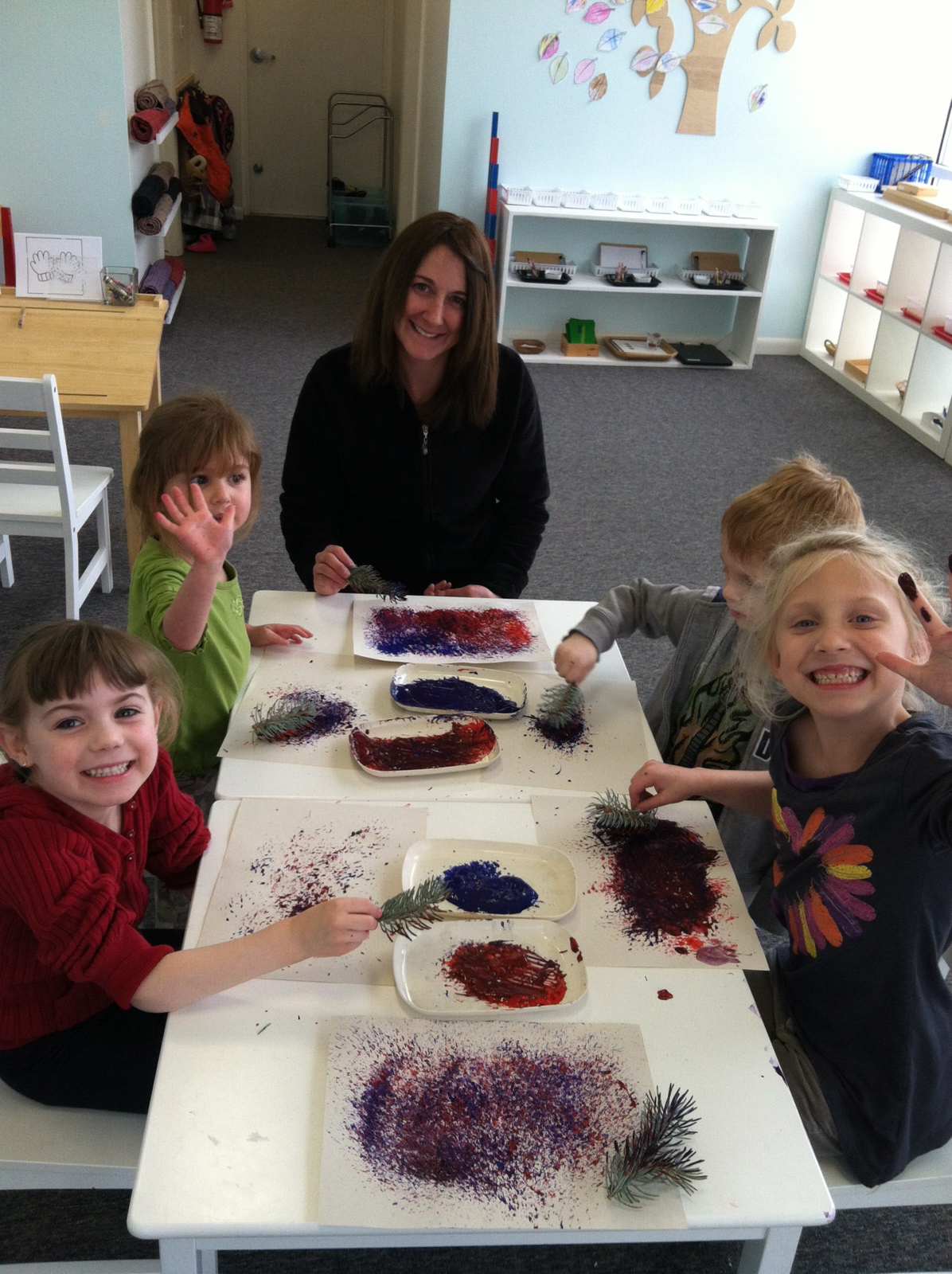
Valentines for the birds.
QUALITY. AFFORDABLE. MONTESSORI PRESCHOOL in North Ogden, Utah. Ages 3-6 Accessible, Authentic and High Quality Early Childhood Education
Monday, February 25, 2013
Monday, February 11, 2013
Practical life fun for February!
Wednesday, January 30, 2013
Monday, December 17, 2012
Thursday, April 12, 2012
Friday, January 27, 2012
Thoughts From Needra on Math and Geometry
EXPERIENCE FIRST
The concepts of math and geometry as symbols on paper make sense after sensorial experience. Removed from real objects these studies become dry and meaningless. Children naturally have an interest in all aspects of mathematics, weight, order, systems, series, time, quantities and symbols, and so forth. We can serve the development of the mathematical mind by feeding this interest, giving sensorial experiences first, and only then their representatives on paper.
Sometimes people think there is something magic about sensorial math materials. Yes, the materials are certainly ingenious, but the real value of manipulatives is that they support the natural love of math concepts and activities that occurs early in life. These activities include: counting, sorting, classifying objects, experiences with series of sizes and colors, weighing and measuring, carrying out housework such as dish washing, with many sequential, logical steps—these are activities that nourish the mathematical mind.
MANIPULATIVE MATERIALS
When the first Casa dei Bambini in Rome was opened in the beginning of the 20th century the children were not taught math until they asked if they could study it. It was when the 3-6 children asked to use the math materials from the elementary classes and were more successful at learning these concepts (!) that math began to be an important part of Children’s Houses for children from the age of three to six.
Many people misunderstand, at first, what it means to learn math at this age. They remember how they learned the multiplication tables for example—tedious and boring, hours of painful repetition that was certainly not the first choice of activities.
In the 3-6 class, children love to learn the quantities and symbols for numbers in the thousands. They often learn addition, subtraction, multiplication and division with the decimal system and with fractions, simultaneously.
None of this work is required of the children, but it is offered, presented with manipulative materials to one child at a time—by the adult and sometimes another child. There are no teachers lecturing to a group of children who are required to sit still and listen. The children choose this work, and repeat each step with joy and enthusiasm until they are ready to move to the next step.
Certainly not every child masters or even works with every piece of math material in the 3-6 class. The main point is that an enjoyable and interesting introduction to all of the areas of geometry and math are present in the environment. The child is introduced to each activity as she is ready, and given the choice of whether or not to continue to work with it. In the meantime, she is surrounded by other children joyfully exploring math.
Math and geometry are presented and treated in the same way as art, building with blocks, music, gardening, and all other subjects. What a different and wonderful introduction to a subject detested and feared by many of us adults.
A child who is allowed to explore with real mathematical objects at an early, motor-sensorial age stands a good chance of becoming a real math lover later in life. If his passions lie elsewhere, at least he will be exempt from the math phobia that so many of us experience because of our own less-than-joyful introductions to this area of learning.
Math and geometry materials do not have to be expensive; they can be made of cardboard cubes, strings of beads, blocks, and beans, anything that helps the child grasp the concept through her senses.
In fact, the more one uses everyday objects for comparing, measuring, counting, and carrying out any other mathematical processes, the more math becomes a part of the real, practical, everyday life of the child.
Wednesday, December 14, 2011
Sensorial Education in Montessori
Sensorial Materials and education of children often take a back seat to Math and Language. Mostly, because it is easier to measure progress and successes in the areas of Math and Language. Also, because reading and understanding simple math processes are the 'standard' measure of success that most parents look for. Sensorial education is just as important as the other subjects in Montessori. In fact it is the preparation for ALL critical thinking and observation.
The Sensorial materials are designed to be very unique and interesting to a the child. Generally, they have nothing like this at home and this naturally interests them.
The Materials prepare and refine the senses used to take in knowledge.
Their natural curiosity and need to "touch everything" is the inner drive to gather information from the world around them. This desire is encouraged and they find gathering this raw data, and to classify it deeply satisfying.
Dr. Montessori said: "We cannot create
observers by saying observe, but by giving them the power and the means
for this observation and these means are procured through education of
the senses. "
When a child manipulates any of the Sensorial Materials they are gaining a deeper understanding of the world and the skills and vocabulary to draw information from their surroundings wherever they are. THAT is true education- giving the child the tools to build intelligence independently.
Subscribe to:
Posts (Atom)